One engine · six apps · one file format
Music for people
who don't make music.
Alma is a family of musical software built on a single belief:
simple, great-sounding music should be within reach for anyone,
with or without musical training. Every app runs on
MusiKa — a one-of-a-kind synthesis engine that
captures the essence of real instruments as formulas,
not samples — and every app speaks the same
.alma file, so your ideas travel freely.
See the apps How the engine works
The apps are in active development
and will be available for download soon.
The MusiKa engine
will be released as open source.
The apps
Five expressive front-ends sharing one engine. Pick the one that fits the moment — a plugin inside your DAW, a pocket tracker on your wrist, or an improvisation game that writes back.
iOS · iPadOS · macOS
Alma DAW
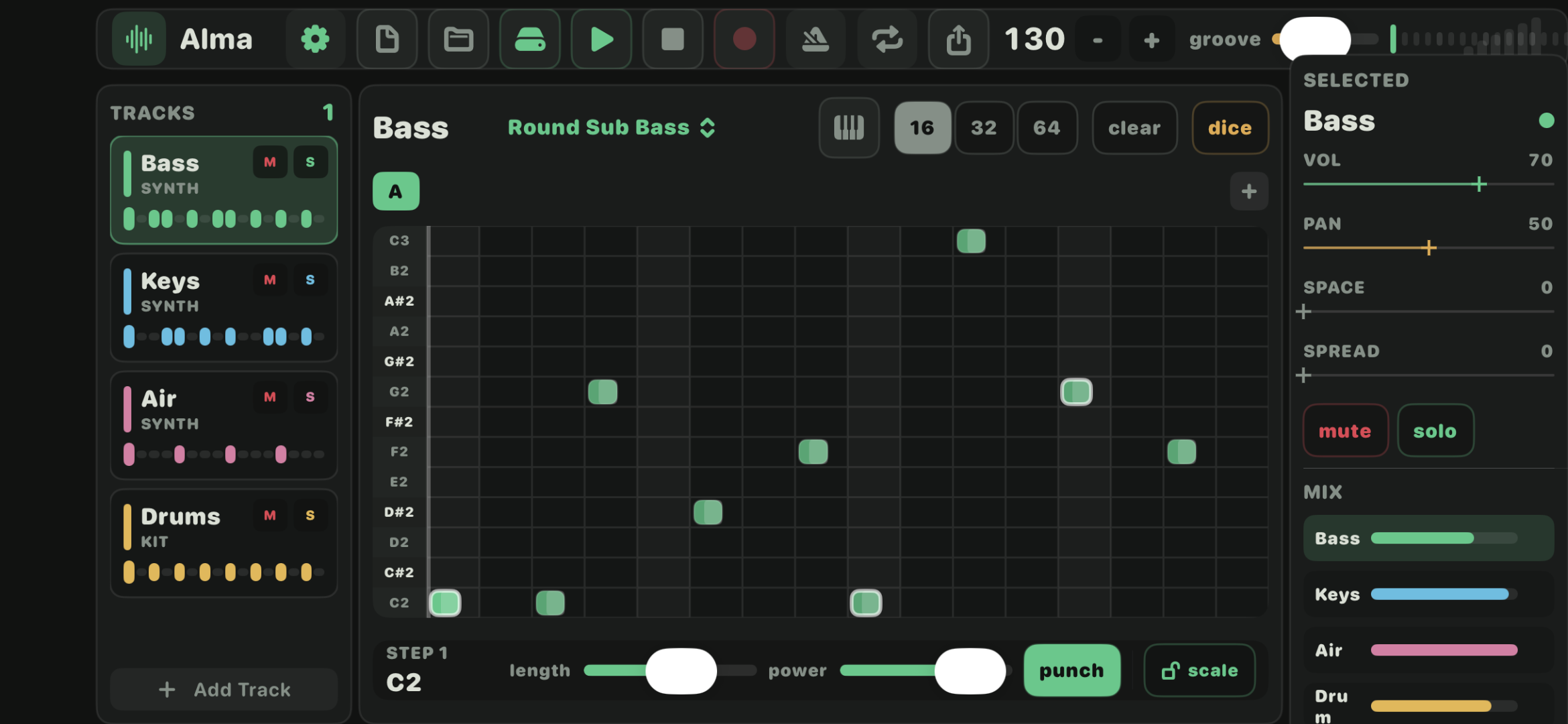
A mini-DAW-meets-groovebox. Up to 32 tracks, 16-step patterns, drum pads, samples and a Custom Wave sound designer — one clean screen, same engine.
Explore →macOS · desktop
Alma DAW for Mac
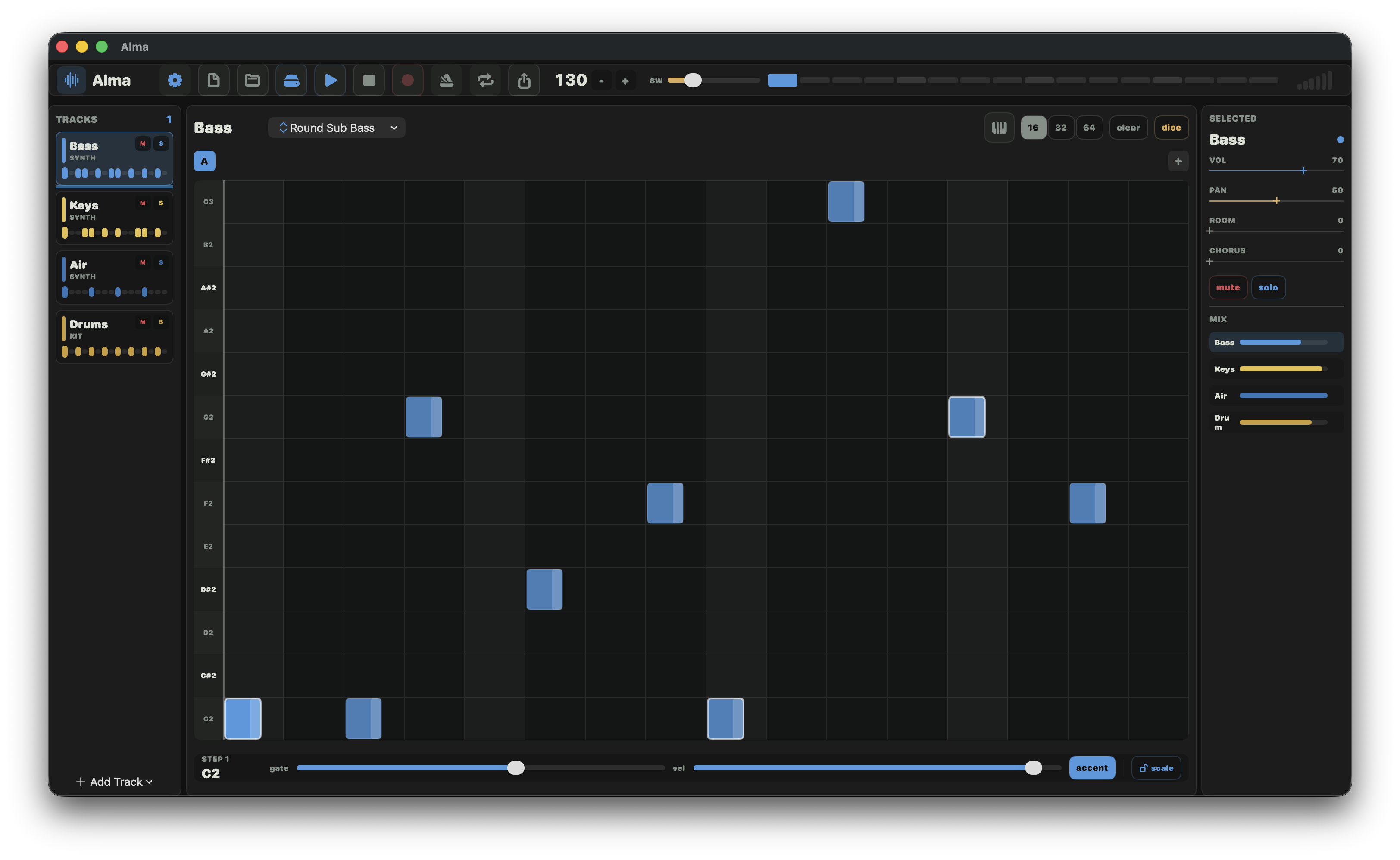
The desktop edition tailored for macOS. More room to arrange, the same patterns and patches as the mobile Alma apps.
Explore →iOS · iPadOS
Alma Track
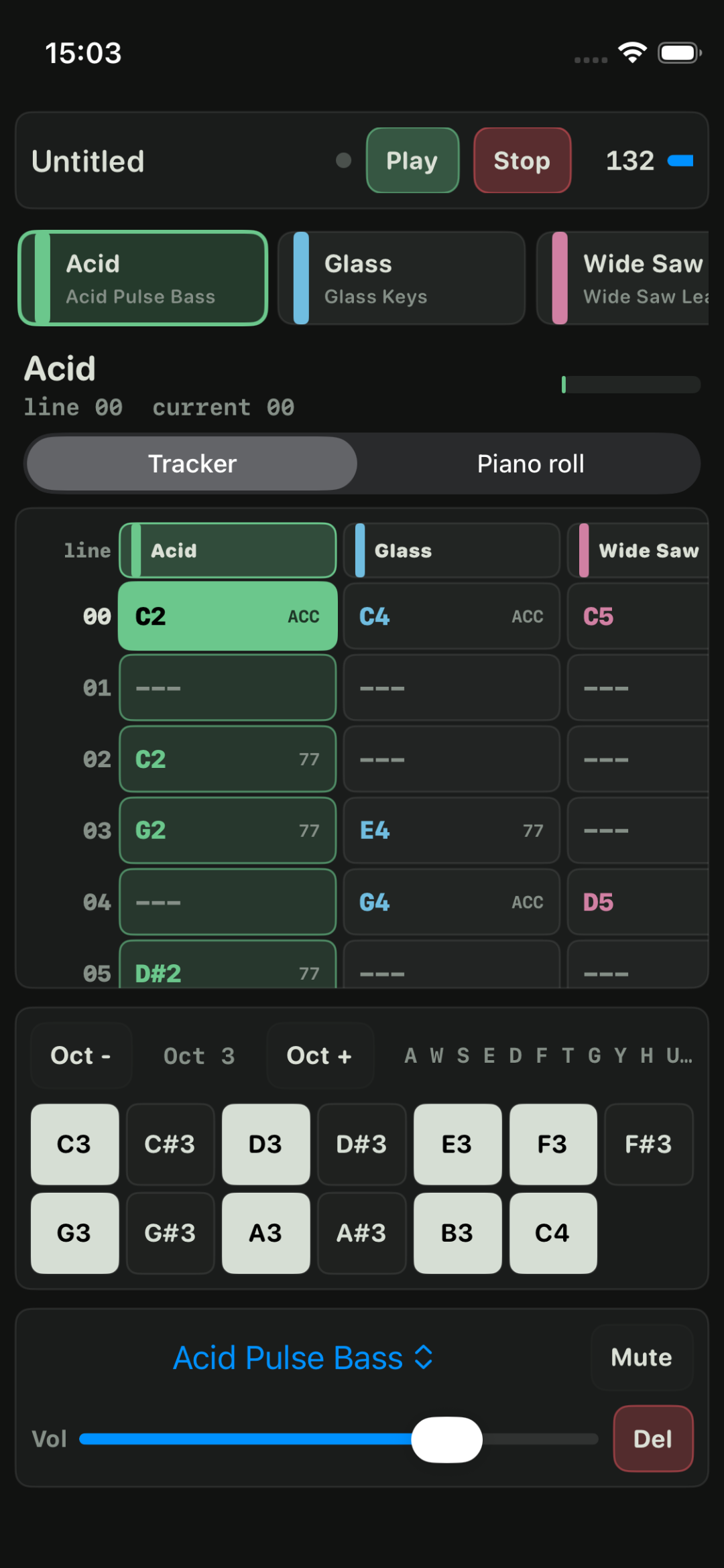
A focused, tracker-style companion for quick pattern
sketching on the move. Opens and saves the same
.alma file as its siblings.
macOS · AUv3
Alma Synth
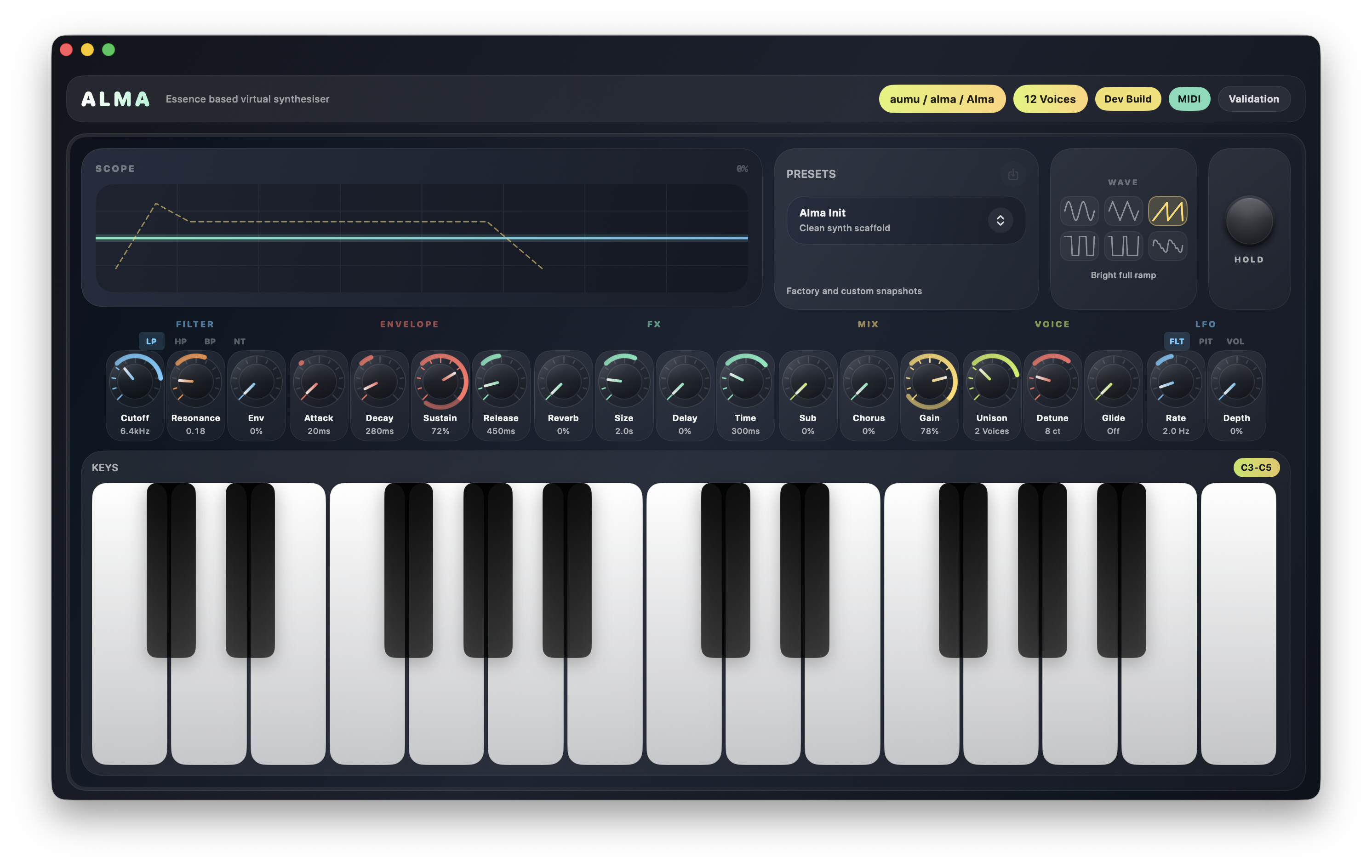
The origin point. A macOS Audio Unit v3 instrument plugin where the MusiKa engine first took shape — drop it into any AUv3 host.
Explore →iOS · iPadOS · macOS
Alma Groove
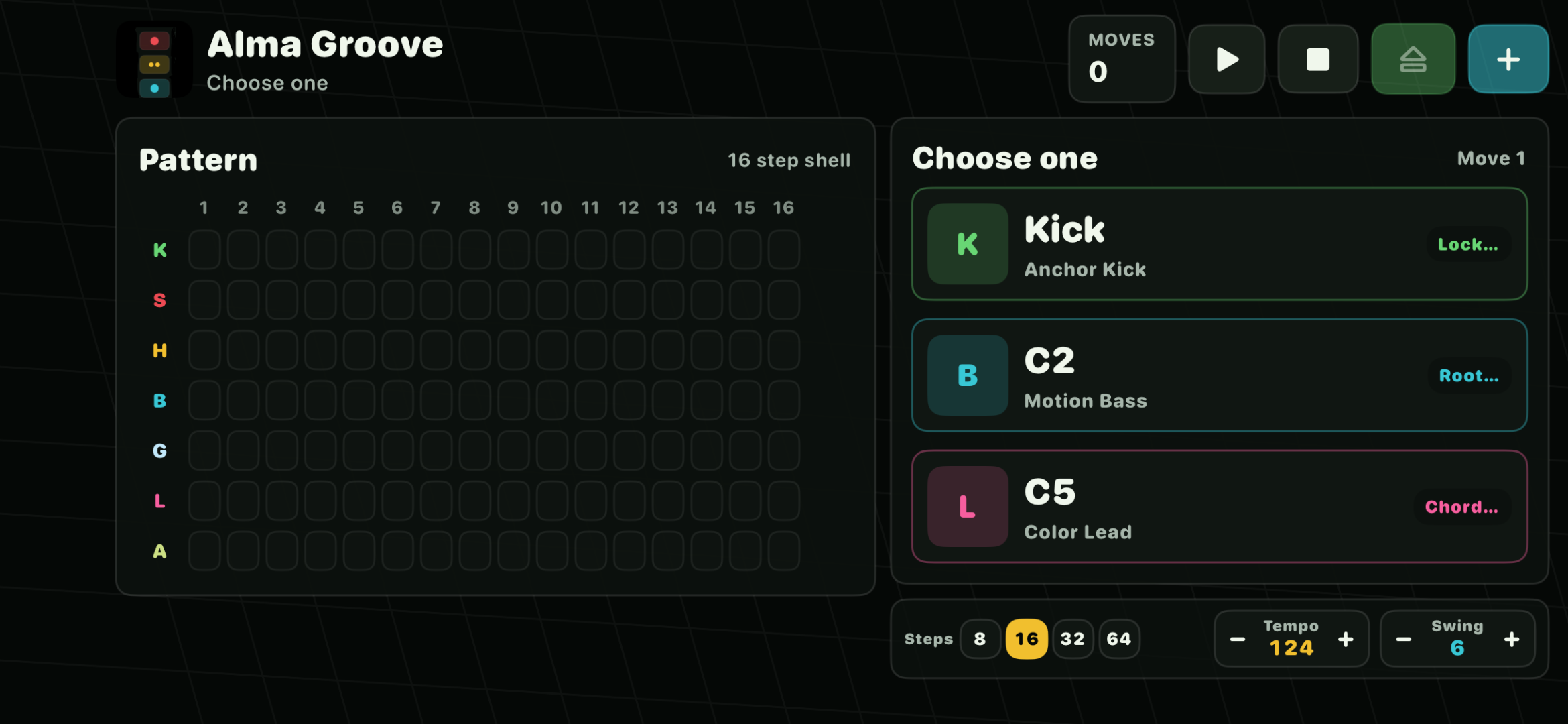
Half instrument, half game. A pseudo-random improvisation playground driven by the same engine — no theory, no grid, just play and react.
Explore →ESP32-S3 · hardware
Alma Tracker S3
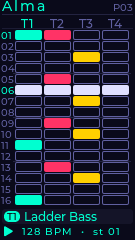
The pocket edition. The MusiKa engine running natively on an M5StickC S3 — two buttons, one wrist, four tracks.
Explore →Instrument essence
We don't record instruments. We listen to them.
A sampler captures a single pluck of a string as a tiny audio clip and plays that clip back. MusiKa does something different: it studies an instrument — its shape, its behaviour, the way it breathes — and rebuilds it from first principles, in code. The result isn't a recording of the sound; it's a miniature version of the instrument itself.
A note on scope. MusiKa models electronic instruments — analog and digital synthesizers, drum machines, classic groove boxes, bells, plucks and modal resonators. We are not trying to shrink a concert grand piano or an acoustic guitar recorded in a cathedral into a kilobyte. Those live instruments belong in a studio and a microphone. MusiKa's territory is the world of circuits, waveforms and envelopes — the instruments that were already built out of formulas to begin with.
What we extract
For each instrument we identify the pieces a player can feel: the body (its characteristic harmonics), the behaviour (how it attacks, sustains and releases), the voice (filter resonance, drive, saturation) and the motion (vibrato, chorus, the small irregularities that make it feel alive).
Why it matters for players
Because a sampled string plays the same pluck every time — a MusiKa patch plays a new one at every velocity, every length, every aftertouch nudge. It responds like an instrument, not like a tape. And because a whole kit fits in a kilobyte, it fits on a watch-sized board as easily as inside your DAW.
Distilled from thousands of samples
Every patch in MusiKa is the distillation of thousands of audio samples of that instrument — different notes, velocities, recording chains and eras — analysed, cross-referenced and condensed until only the formulas that actually matter remain. None of those samples are shipped, stored or redistributed. What lives on, inside MusiKa's code, is their essence: the rules that made them sound the way they sounded.
Built with AI, end to end
The analysis pipeline leans heavily on machine learning. Classifiers identify what each sample is and which instrument it comes from; spectral and envelope extractors pull out the underlying parameters; a curation step picks the smallest set of formulas that reproduce the character of the source. AI did the heavy lifting; humans shaped the taste.
The samples themselves stay where they belong — with their owners. MusiKa only carries the knowledge learned from them.
MusiKa · the engine
MusiKa is a tiny, portable C synthesis core. What makes it one-of-a-kind is how it captures a sound: instead of storing megabytes of samples, it derives the formulas behind each instrument — its harmonics, its envelope, its modulation fingerprint — and ships them as ~1 KB algorithmic patches.
The same code runs inside an AUv3 plugin, an iPad DAW, a macOS standalone, an improvisation game and an ESP32 microcontroller. Small enough for silicon that costs a few dollars; faithful enough for a desktop DAW.
The focus is deliberately narrow: electronic instruments only — synths, drum machines, bells, plucks. Acoustic realism isn't our goal; playability and character are.
What ships in every app
- Polyphonic voice engine with MIDI 1.0 and 2.0 note handling.
- Multiple oscillator flavours — analog, FM, wavetable, modal, Karplus-Strong, drum voice.
- Filters & FX — SVF, ladder, diode, chorus, drive, reverb.
- Factory patches derived from real instruments via essence extraction.
- One file format —
.almacarries song, pattern, patch and mix data across every app. - Open source — the engine will be released under a permissive license so anyone can port it, embed it, or build on it.
Factory patch bank
Ten sounds ship with every app and every device. Each one is a formula — oscillator topology, filter, envelope, modulation — distilled from a real instrument, rebuilt from scratch, and typically under a kilobyte of C code.
| # | Patch name | Model | Engine | Character |
|---|---|---|---|---|
| 01 | Classic Kick | Box-8 | Drum voice | Deep sine thump with fast pitch drop — the room-shaking 80s rhythm-box kick. |
| 02 | Punch Snare | Box-9 | Drum voice | Triangle + noise body, HP-filtered — the digital rhythm-box snare that defined a generation. |
| 03 | Metal Hat | Box-9 | Drum voice | Bright noise burst through a high-pass — closed hi-hat from the same machine. |
| 04 | Acid Bass | Silver-B | Mono + glide | Saw through a resonant diode ladder — the squelch that started a whole genre. |
| 05 | Supersaw Lead | Hyper-P | Virtual analog | Seven detuned saws in unison — the widescreen 90s trance lead. |
| 06 | Chorus Pad | J-6 | Subtractive poly | Two ensemble-detuned saws into a creamy LP — Japanese poly warmth. |
| 07 | FM E.Piano | FM-7 | FM | Two-operator bell with slow decay — the 80s digital electric piano. |
| 08 | Ladder Bass | Mini-M | Subtractive mono | Three oscillators into an overdriven ladder — the American monosynth bassline. |
| 09 | KS Pluck | Karplus | Karplus-Strong | Noise exciter fed into a tuned delay — acoustic string modelling in a handful of lines. |
| 10 | Modal Bell | Modal | Modal resonator | Struck metal partials — bells, tines, glassy mallets. |
Names and model codes are allusive — the formulas are our own.
What the engine exposes
The formulas inside a MusiKa patch aren't a fixed recipe — they're a full synthesizer's worth of parameters, all open to you. This is the toolbox the factory patches are built from, and the same toolbox you use to design your own sounds.
| Section | Parameters | Range / options |
|---|---|---|
| Synthesis mode | Overall engine topology | Subtractive · Virtual analog · FM · Wavetable · Additive · Karplus-Strong · Modal · Acid mono · Drum voice |
| Oscillators | Up to 3 osc (6 for FM), wave, coarse / fine, level, pan, PWM, hard sync, phase, ring-mod, cross-mod | Sine · Triangle · Saw up/down · Square · Pulse · Supersaw · White / Pink noise · Wavetable · FM operator |
| Unison | Voices, detune, stereo spread | Up to 8 voices per osc · 0–100¢ detune · 0–1 stereo |
| Wavetable | Bank, morph position, bend / warp | Built-in · extracted · harmonic · 0–1 morph |
| FM | Ratio, index, feedback, operator, algorithm | 6 operators · 32 classic algorithms · DX-style 4-rate / 4-level envelope mode |
| Filter | Type, cutoff, resonance, drive, env amount, LFO amount, keyboard tracking, accent | 4-pole ladder · diode ladder · Curtis-style LP · 2-pole SVF LP/HP/BP/notch · formant (vowel morph) |
| Envelopes · ×3 | Amp, filter, mod — delay · attack · hold · decay · sustain · release, per-segment curve, velocity → attack / sustain | 0–30 s per segment · linear / log / exponential curves · optional DX 4R4L mode |
| LFOs · ×2 | Wave, rate, depth, delay, fade-in, start phase, sync mode | Sine · Tri · Saw · Square · S&H · Free · Key-sync · Beat-sync |
| Modulation matrix | Free routing from any source to any target with signed depth | Up to 16 routes · 12+ targets (pitch, cutoff, res, amp, pan, PWM, wave pos, FM ratio / index, unison detune, reverb size…) |
| Effects chain | Up to 8 insert / send blocks with per-effect parameters | Chorus · Flanger · Phaser · Delay · Reverb · Drive · Bitcrush · Shelving EQ |
| Voice & global | Polyphony, glide, legato, pitch-bend range, transpose, detune, master vol / pan | Poly · Mono · Unison · Arp · up to 32 voices · glide 0–5 s · bend 0–24 st |
| Analog drift | Per-voice random-walk on pitch and filter cutoff | 0 = perfectly digital · up to ±50¢ pitch · up to ±1 octave cutoff |
| Additive partials | Freq ratio, amplitude, phase, per-partial decay | Up to 48 partials (modal / additive synthesis) |
| Acid sequencer | Note, accent, slide, gate, swing | 16 steps · 0–99 % swing (drives the mono acid voice) |
Roughly 80 first-class parameters per patch. This is what the AI pipeline learns to set; this is what you override when you design a sound of your own.
The philosophy
Most music tools assume you already know what a scale is, what a VST does, and how to route MIDI. Alma doesn't. The goal is the opposite: give someone who never played an instrument the same first-time thrill a musician gets when a song starts coming together.
We do that by keeping the surface tiny and the sound generous. Pick a patch — it already sounds great. Tap a grid, or tilt a device, or let Alma Groove improvise back at you. If you want more, every app scales up; if you just want fun, none of them get in your way.
Shared by design
- One engine — MusiKa, in portable C.
- One file format —
.alma, readable by every app on every platform. - One aesthetic — quiet, minimal, single-accent interfaces.
- One audience — anyone curious enough to press play.